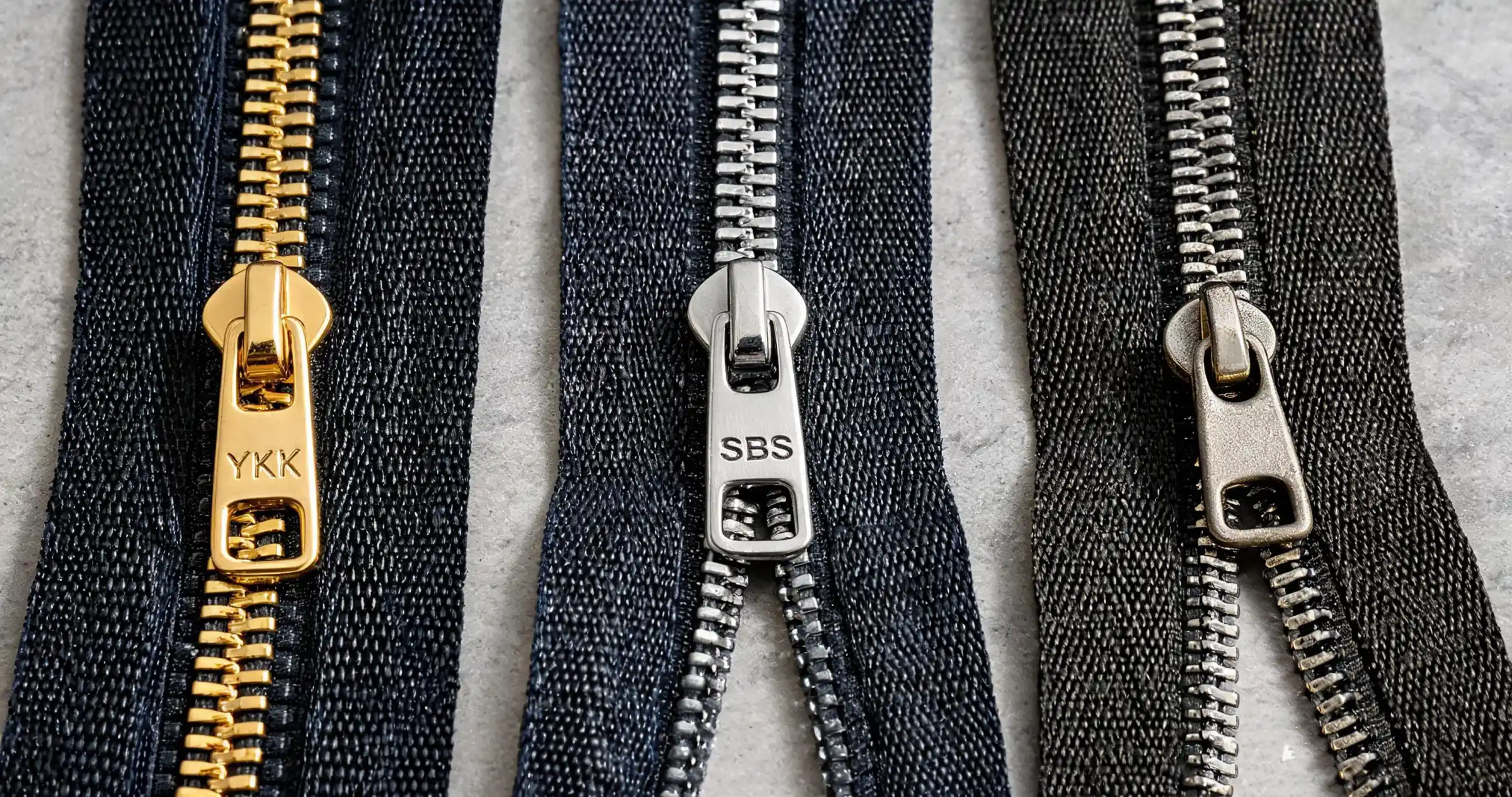
YKK zippers appear on products made by Louis Vuitton, Nike, Patagonia, and thousands of brands across every price point. The YKK logo on a zipper pull has become shorthand for quality — to the point where experienced buyers treat it as a proxy for overall product standards.
But is that reputation earned? And does the choice actually matter for your custom bag?
The short answer: it depends on your price point, your product category, and what failure costs you. This article breaks down what separates zipper brands, who the main players are, and how to make the right call for your specific order.
What Makes One Zipper Better Than Another?
Before comparing brands, it helps to understand what quality actually means in a zipper. Five variables matter:
Teeth consistency
Zipper teeth need to interlock precisely and uniformly. Inconsistent teeth cause the slider to skip, jam, or separate under tension. High-quality manufacturers use tighter dimensional tolerances — teeth are more uniform in size and shape across an entire production run.
Slider smoothness
The slider is the part that opens and closes the zipper. A well-engineered slider runs smoothly with consistent resistance. A poorly made slider binds, catches, or requires force — and the internal mechanism wears out faster.
Tape quality
The zipper tape — the fabric strip the teeth attach to — needs to resist fraying, stretching, and delamination. Low-quality tape fails at stress points before the teeth do.
Plating and finish durability
Metal zippers are plated to achieve their color and finish. Plating that doesn't adhere properly or lacks adequate thickness will flake, tarnish, or discolor within months — especially on bags exposed to moisture, sweat, or abrasion.
Cycle durability
How many open-close cycles before failure? A standard YKK #5 coil zipper typically exceeds 10,000 cycles without tape fraying. Budget-tier alternatives begin showing teeth misalignment around 4,000 cycles — a meaningful gap for a bag used daily over two or more years.
The Main Brands — and Where They Sit
| Brand | Origin | Positioning | Typical Users |
|---|---|---|---|
| YKK | Japan | Mass market to premium | Nike, Patagonia, The North Face, Coach, Chanel (select collections) |
| RiRi | Switzerland | Luxury | Prada, Gucci, high-end fashion bags |
| Lampo | Italy | Luxury / fashion | Chanel (certain collections), Italian luxury goods |
| SBS | China | Mid-market OEM | High-volume OEM production, mid-range retail bags |
| Generic / Unbranded | Various | Budget | Promotional bags, fast fashion, single-use gifting |
💡 Note on Chanel: Chanel has used YKK, RiRi, and Lampo across different collections. The takeaway: even at the top end of the market, the decision is about performance and QC standards — not loyalty to a single zipper brand.
YKK vs SBS: The Practical Comparison
For most custom bag projects, the real decision is YKK versus SBS. RiRi and Lampo are luxury-tier and priced accordingly — rarely relevant for OEM brands at accessible or mid-market positioning. Unbranded generics are a separate category covered below.
| YKK | SBS | |
|---|---|---|
| Unit cost premium | ~$0.40–$0.70 more per zipper (FOB China, 2026) | Lower baseline cost |
| Defect rate | Near-zero; ~1 in 10,000 at incoming inspection | Good QC; failure rate difference vs YKK under 1.5% in standard use |
| Cycle durability | 10,000+ cycles without tape fraying (standard #5 coil) | Comparable in normal use; wear shows earlier under extreme lateral stress |
| Color consistency | Highly consistent across batches and reorders | Improved significantly; minor batch variation possible |
| Slider feel | Self-lubricating; gets smoother with age | Smooth in standard applications; varies by product line |
| Consumer recognition | Strong positive signal with end consumers | Not recognized by end consumers; neutral perception |
| Compliance docs (REACH/RoHS) | Full documentation via authorized distributor network | Available; requires verification with specific supplier |
The Perception Factor: What Happens When Something Goes Wrong
There is one dimension that doesn't show up in lab tests: the blame dynamic.
When a customer has a problem with a bag and sees a YKK zipper, they tend to blame the bag design or their own use. When they see an unknown brand — or no brand at all — they attribute the problem to "cheap quality," and that perception extends to the entire product and the brand behind it.
This asymmetry matters for brands that depend on reviews, repeat purchases, and word of mouth. A $0.50 zipper upgrade on a bag retailing at $150 is a rounding error on margin — but it removes a perception risk that can generate returns and negative reviews out of proportion to its actual frequency.
A documented case from OEM sourcing: a buyer substituted YKK with SBS on a heavy-duty tool bag to save $0.50 per unit. Six months post-delivery, 15% of units were returned due to zipper failure under high lateral load. The cost of returns, reshipping, and replacements eliminated the savings many times over. For load-bearing zippers on functional bags, specifying YKK is the lower-risk choice.
What About Unbranded Generic Zippers?
Generic unbranded zippers are a different category from SBS — and the gap is more significant than YKK vs SBS.
Unbranded zippers have no consistent quality standard, no accountability on specifications, and no batch-to-batch consistency. They look fine when new. The problems show up at 3,000–4,000 cycles: teeth misalignment, tape fraying, slider binding, plating flaking.
There is one scenario where generics are appropriate: promotional bags, gift-with-purchase items, and single-use products where the expected life is short and the retail price makes a YKK or SBS spec economically unviable.
For anything a customer will use repeatedly — any bag carrying your brand name — unbranded zippers are a false economy.
⚠️ Industry warning: If you leave the zipper brand unspecified in your tech pack, some factories will substitute the cheapest available zipper to protect their own margin. This is a known practice. Always specify brand, size, color code, and finish in your written production specification.
YKK Product Lines Worth Knowing
YKK is a large family of zipper types optimized for different applications. The most relevant for bag production:
EXCELLA® — Premium metal zipper. Elements are individually polished and plated before attachment, producing an exceptionally smooth surface and a luxurious appearance. Best for fashion bags, clutches, and accessible luxury positioning.
EVERBRIGHT® — High corrosion-resistance metal zipper with chemical polishing and lacquering. Retains color and gloss over time. Good choice for mid-to-upper market bags with metal zippers.
Standard #3, #5, #8 Coil (RC) — The workhorses. Nylon coil in three sizes: #3 for inner pockets and fine openings, #5 for main compartments on everyday bags, #8 for luggage, duffles, and high-load openings. The most widely used YKK products in custom bag production.
Aquaguard® — Water-resistant zipper with a laminated backing that prevents water intrusion. For outdoor bags, travel bags, and waterproof applications.
A Simple Decision Framework
| Scenario | Recommendation |
|---|---|
| Retail bag, $100+ price point | YKK — quality signal matches price point; consumer recognition matters |
| Tactical / tool / functional bag, any price | YKK — load-bearing zippers where failure is unacceptable |
| Everyday bag, $50–$100 retail | YKK or SBS — specify main compartment as YKK minimum; inner pockets SBS acceptable |
| High-volume fashion bag, under $40 retail | SBS — comparable performance at lower cost; avoid generic/unbranded |
| Promotional / gift-with-purchase bag | Generic acceptable — short expected life, cost is primary driver |
| Luxury / accessible luxury bag | YKK EXCELLA® or RiRi — product positioning requires the best |
| EU market, compliance documentation required | YKK — full REACH / RoHS documentation via authorized distributors |
Always Specify in Your Tech Pack
Whatever zipper decision you make, document it in writing. Your tech pack should specify:
- Brand (YKK / SBS / other)
- Product line (if YKK: coil, EXCELLA®, Aquaguard®, etc.)
- Size (#3, #5, or #8)
- Color code
- Finish (gold, silver, gunmetal, antique brass)
- Slider type (non-locking for handbags; locking for travel or security applications)
A zipper spec left blank is an open invitation for substitution. Factories are working to hit the unit cost you've agreed on — if you haven't specified, they'll make that call themselves, typically in favor of their margin rather than your product quality.
Sourcing a Custom Bag?
We'll Help You Nail Every Hardware Detail
From zipper brand and size to pull finish and slider type — our Dongguan R&D team helps you get the spec right before sampling starts. No minimum order quantity.
Get a Free Quote →