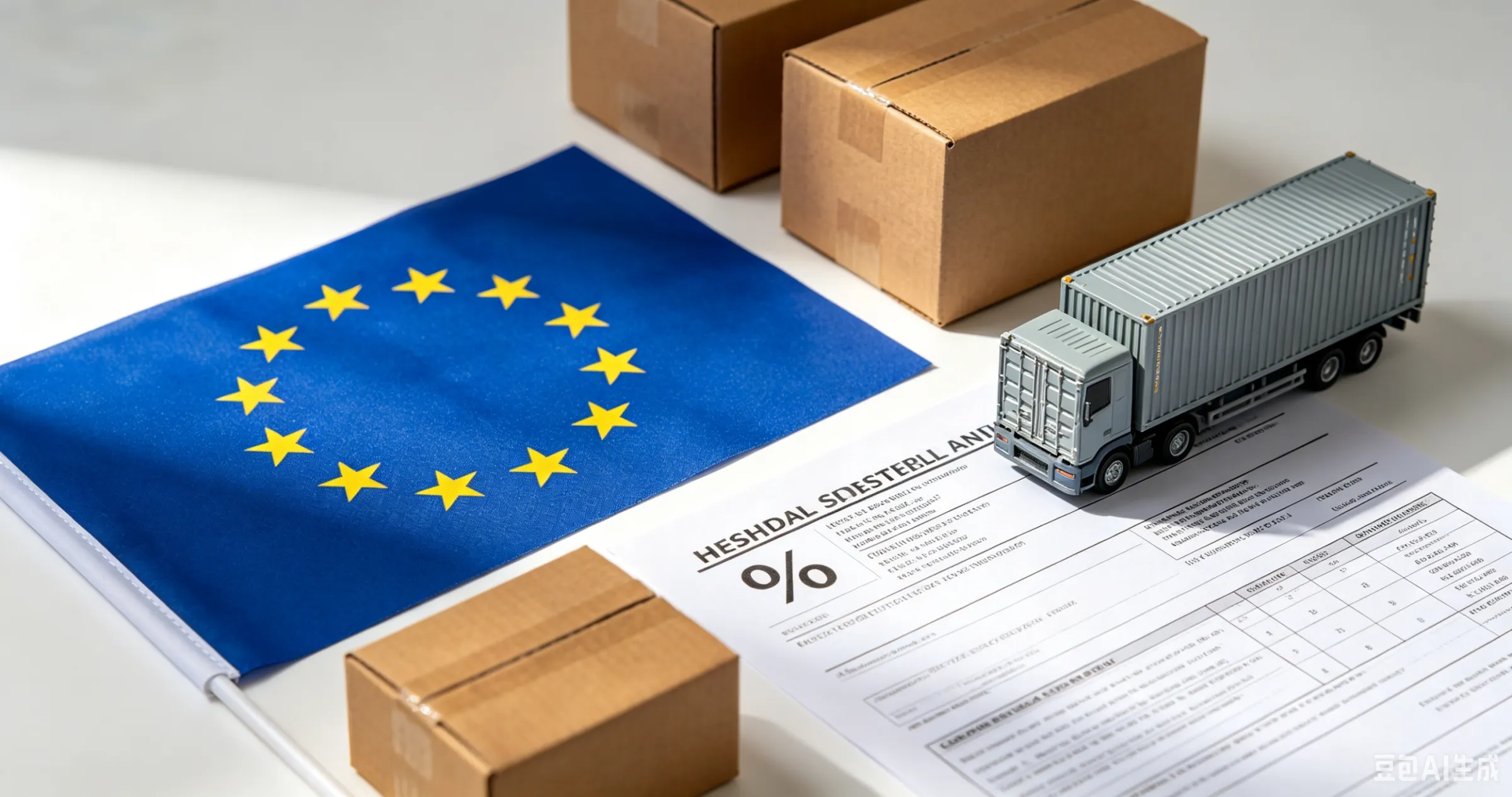
If you're a European brand, retailer, or buyer importing handbags from China, understanding the EU's import duty structure is a non-negotiable part of your landed cost calculation. Get it wrong, and your margins look very different at the border than they did on the purchase order.
This guide covers how EU import duties on handbags work, what the actual rates are by product type, how VAT layers on top, and what changed in 2026 that every importer needs to know about.
How EU Import Duties Work: The Basics
The EU operates a unified customs tariff — meaning the same duty rate applies regardless of which EU member state your goods enter through. The system used is called TARIC (Tarif Intégré de la Communauté / Integrated Tariff of the European Communities), which extends the international HS code system to 10 digits for EU-specific precision.
For bags and travel goods, the relevant HS chapter is Chapter 42, with most handbags classified under heading 4202. The exact subheading — and therefore the exact duty rate — depends primarily on the outer surface material of the bag.
💡 Important: The outer surface material determines classification — not what the bag is filled with or what the lining is made of. A PU leather bag with a polyester lining is classified as a PU leather bag. A nylon bag with a leather patch is classified based on which material makes up the dominant outer surface.
EU Import Duty Rates by Bag Type (2026)
The following rates are the MFN (Most Favoured Nation) third-country duty rates applicable to imports from China under the EU TARIC system:
| HS Code | Product Description | EU Duty Rate | Examples |
|---|---|---|---|
| 4202.11 | Briefcases, executive cases — leather outer | 3% | Leather briefcases, document bags |
| 4202.21 | Handbags — leather or composition leather outer | 3% | PU leather handbags, faux leather shoulder bags |
| 4202.22 | Handbags — textile outer surface | 3.7% | Canvas handbags, nylon fashion bags |
| 4202.29 | Handbags — other outer surface (plastic sheeting) | 3.7% | Clear PVC bags, plastic-coated bags |
| 4202.92 | Other bags — textile outer (backpacks, totes, sports bags) | 3.7% | Nylon backpacks, polyester totes, Oxford fabric bags |
| 4202.91 | Other bags — leather outer (backpacks, travel bags) | 3% | Leather backpacks, leather travel bags |
Compared to the US, EU import duties on bags from China are strikingly low — 3% to 3.7% versus the US composite rate of 34–52%. This is one of the reasons European buyers are in a structurally more favorable position than US buyers when sourcing from China right now.
The PU Leather Classification Question
PU leather (polyurethane-coated fabric) is one of the most widely used materials in bag production — and also one of the most commonly misclassified at customs.
The key question customs authorities ask: does the outer surface have the appearance of leather?
- If yes — it's likely classified as composition leather under 4202.21, attracting the 3% duty rate
- If the textile backing is visible or dominant — it may be classified as textile outer surface under 4202.22, attracting 3.7%
In practice, most smooth and embossed PU leather bags (croc, python, suede-finish PU) are classified under 4202.21. If you're importing high volumes of PU leather bags, it's worth confirming the correct subheading with your customs broker before your first shipment — or applying for a Binding Tariff Information (BTI) ruling from your national customs authority for legal certainty.
VAT: The Bigger Number
EU customs duty is only part of your import cost. VAT — charged by each member state on the CIF value plus customs duty — is typically a much larger number.
VAT is charged at the destination country's standard rate, applied to the customs value + customs duty:
| Country | Standard VAT Rate | Country | Standard VAT Rate |
|---|---|---|---|
| Germany | 19% | France | 20% |
| Netherlands | 21% | Italy | 22% |
| Spain | 21% | Poland | 23% |
| Sweden | 25% | Denmark | 25% |
| Luxembourg | 17% (lowest) | Hungary | 27% (highest) |
VAT is reclaimed by VAT-registered businesses importing for resale — so for B2B buyers, VAT is a cash flow item, not a permanent cost. For end consumers or non-VAT-registered importers, it's a real cost.
How to Calculate Your Landed Cost: A Worked Example
Suppose you're importing 500 PU leather crossbody bags from China into Germany:
| Cost Component | Calculation | Amount |
|---|---|---|
| FOB value (factory price) | 500 units × €12 | €6,000 |
| Freight + insurance (CIF) | Approx. | €600 |
| CIF customs value | FOB + freight + insurance | €6,600 |
| EU customs duty (3% × €6,600) | 4202.21 rate | €198 |
| VAT base (CIF + duty) | €6,600 + €198 | €6,798 |
| German VAT (19% × €6,798) | Reclaimable for VAT-registered businesses | €1,291.62 |
| Total landed cost (before VAT reclaim) | €8,089.62 |
For a VAT-registered importer, the effective additional cost beyond the factory price is the customs duty only (€198) — adding just 3% to the purchase cost. VAT is reclaimed in the normal VAT return cycle.
What Changed in 2026: The De Minimis Reform
The most significant EU customs change in 2026 affects small-value shipments — and it has major implications for DTC brands and e-commerce sellers shipping directly to European consumers.
From July 1, 2026, the EU is eliminating the €150 de minimis exemption for goods from non-EU sellers. Previously, goods valued under €150 entered the EU without customs duty. Under the new rules:
- A €3 customs duty per item (per tariff classification) applies to all low-value parcels from non-EU sellers
- An additional €2 per-parcel handling charge will apply from late 2026
- VAT has already applied to all such shipments since 2021 under IOSS rules
📌 What this means in practice: A parcel containing three different bag styles from China attracts three separate €3 charges (€9 total) plus the €2 handling fee — €11 in duties on what might be a €30–40 shipment. For platforms like Shein and Temu, and for DTC brands shipping direct from China to EU consumers, the economics of the direct-ship model have fundamentally changed. Importing in bulk and distributing within the EU is now the more viable model.
Practical Checklist for EU Importers
- Verify your HS/TARIC code before importing — especially for PU leather bags where 4202.21 vs 4202.22 classification can be disputed. Use the EU's official Access2Markets tool or consult a customs broker.
- Consider a BTI ruling for high-volume SKUs — a Binding Tariff Information ruling gives you legal certainty on classification and protects you from reclassification disputes at the border.
- Calculate on CIF value, not FOB — EU customs duty is applied to the CIF value (cost + insurance + freight to EU border), not the factory price.
- Register for IOSS if shipping low-value goods direct to EU consumers — the Import One-Stop Shop scheme simplifies VAT compliance for B2C shipments under €150.
- Plan for de minimis changes — if your current model relies on direct-ship from China to EU consumers, the July 2026 reform materially changes the economics. Bulk import + EU warehouse distribution is the more viable path.
References & Sources
- EU TARIC Database — official tariff rates for HS Chapter 42 (bags and travel goods): Access2Markets
- Dutiable.io — HS Code 4202.21 Leather Handbag: EU 3% duty rate, verified April 2026: dutiable.io
- Carra Globe — EU De Minimis Changes 2026: The €3 Duty That Will Reshape How China Ships to Europe: carraglobe.com
- FreightAmigo — The Impact of HS Codes on Import Duties for Bags, March 2026: freightamigo.com
- Shanghai Garment — Current Tariffs on Clothing Imports from China to Europe, 2025: shanghaigarment.com
- European Commission — How to find the import duty that applies to my product: trade.ec.europa.eu
Sourcing Bags for the European Market?
Get a Transparent Quote From a Certified Factory
ISO 9001, BSCI, GRS certified. Audited by Disney, Target, Primark, and L'Oréal. No minimum order quantity. Quote within 24 hours.
Get a Free Quote →