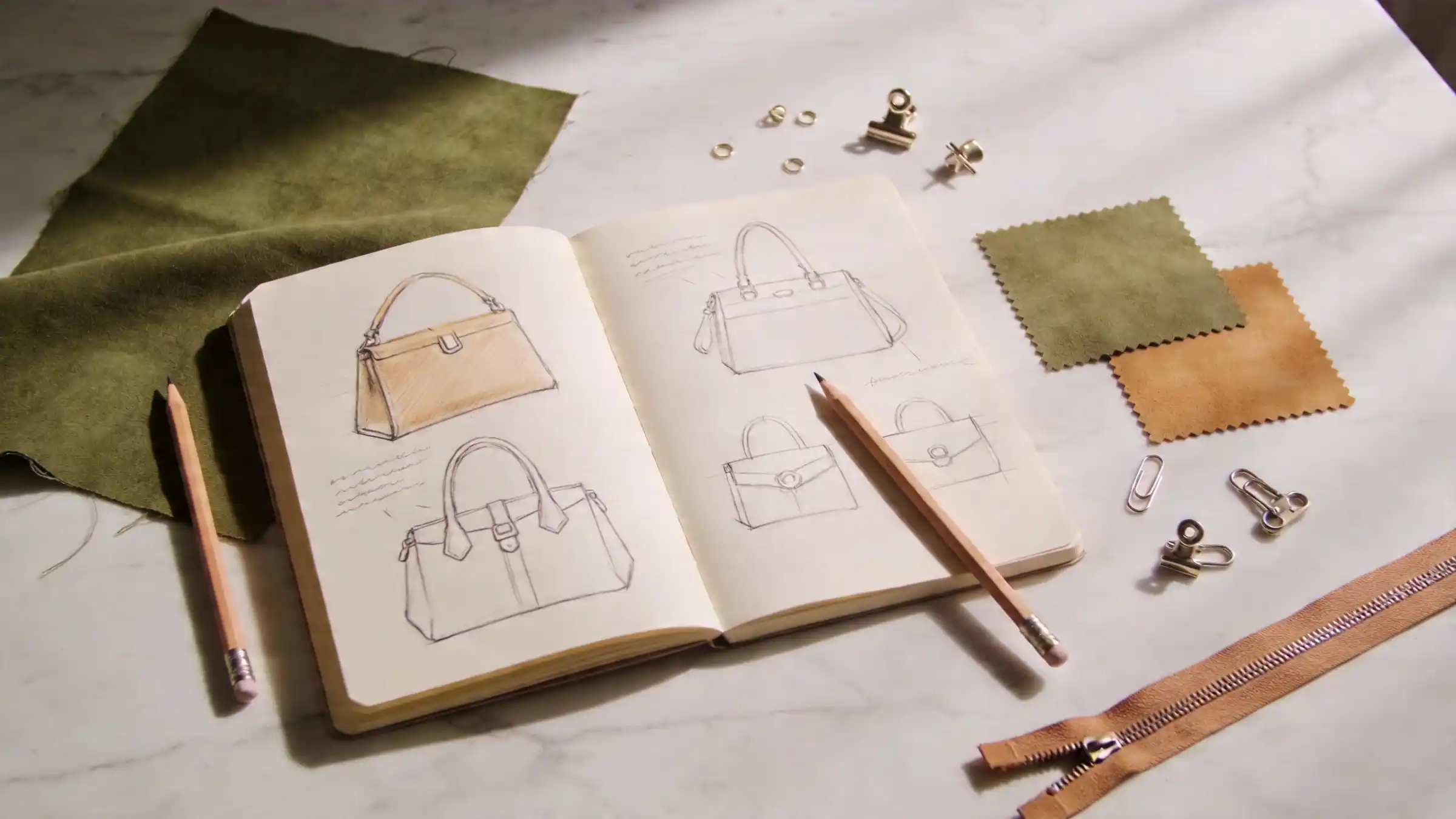
You have a bag in your head. Maybe it's been there for a while — a specific shape, a pocket in exactly the right place, a material you haven't been able to find in anything off the shelf. Or maybe it's newer: a product gap you spotted, a style your customers keep asking for, an idea that came to you and won't go away.
The question isn't whether the idea is good. The question is: how do you actually make it?
This guide walks through the complete process — from a rough concept to a finished, production-ready product — in plain language, without assuming you have a design background or manufacturing experience.
Step 1: Get Your Idea Out of Your Head and Onto Paper
You don't need to be a designer to do this. You just need to communicate your idea clearly enough that someone else can understand it.
Start with a rough sketch — even a bad one. Draw the front, back, and side profile. Mark where the pockets go, where the closure is, how long the strap is. Label the parts you care about most. It doesn't need to be beautiful. It needs to be specific.
If you can't draw, use reference images. Search Pinterest, Instagram, or retail websites for bags that are close to what you have in mind — then annotate what you'd change. "Like this, but with a front zip pocket." "Same shape, but with a top handle instead of a shoulder strap." "This silhouette, in a structured PU leather instead of canvas."
The goal at this stage is a clear reference package: your sketch or images, your notes on what's different, and a rough sense of size. That's enough to start a conversation with a factory.
💡 Tip: Write down the one thing about this bag that matters most to you — the feature, the material, the detail that makes it yours. Keep that non-negotiable. Everything else can be adapted during development.
Step 2: Define the Basic Specifications
Before approaching any manufacturer, you need to make some decisions. You don't need all the answers right away — a good factory will help you fill in the gaps — but the more you've thought through, the faster and cheaper your development process will be.
Size
What are the approximate dimensions? Height, width, and depth. How long is the strap? What's the drop length (distance from top of strap to top of bag when worn)? Even rough numbers help — "roughly 25cm wide, fits a 13-inch laptop" is more useful than nothing.
Material
What should the bag be made of? This is one of the most important decisions, and it directly affects cost, durability, and aesthetic. Common options:
- PU / faux leather — versatile, affordable, available in dozens of textures (smooth, croc-embossed, suede, etc.). Most popular for fashion bags.
- Nylon — lightweight, durable, water-resistant. Great for everyday carry, travel, and sporty styles. Available in 210D (lightweight) to 1680D (heavy-duty).
- Canvas — classic, casual aesthetic. Can be waxed for water resistance. Works well for totes, backpacks, and vintage-inspired styles.
- Genuine leather — premium positioning, higher cost, longer lead times for material sourcing.
Hardware
Zippers, buckles, D-rings, magnetic snaps, bag feet — what finish? Gold, silver, matte black, antique brass? Hardware finish sets the tone of the whole bag.
Closure type
Zip top? Magnetic flap? Drawstring? Buckle? Twist lock? The closure affects both the look and the construction complexity.
Interior
How many pockets? A zip pocket, card slots, a laptop sleeve? What lining material — plain polyester, printed fabric, satin?
Branding
Where does your logo go, and how is it applied? Options include embossing, debossing, woven label, metal plate, screen print, or heat transfer.
You don't need to decide everything before contacting a factory. At Camcue, clients regularly come to us with half a concept and a clear sense of direction — and we work through the material and construction decisions together. What matters is that you know what you want the bag to do and who it's for. You don't even need to understand the technical side of production — what helps us most is knowing your sales channel, your budget, and the context: is this a retail product, a gift-with-purchase, a bundle item? With that information, we can put together a proposal for you to evaluate.
Step 3: Understand Your Two Manufacturing Options
When you bring your idea to a factory, you'll typically be working in one of two modes:
OEM (you design, factory manufactures)
You own the design entirely. The factory executes it to your specifications. Best if your idea is specific and you want full ownership of the product.
Modified ODM (start from an existing style, customize it)
The factory has an existing style library. You pick the closest base and modify it — change the dimensions, add a pocket, swap the closure, update the materials. Faster and cheaper than starting from scratch, and the end result can still be completely unique to your brand.
For most first-time bag creators, modified ODM is the practical starting point. You get the efficiency of a proven base pattern, plus the freedom to make it your own. If your idea is genuinely unlike anything that exists, OEM is the right path — but go in knowing it will take longer and cost more to develop.
Step 4: Find the Right Factory and Make First Contact
Not every factory is the right fit for every product. A factory that specializes in structured leather handbags may not be the best choice for a technical nylon backpack. A factory built around high-volume fast-fashion production may struggle with the attention to detail a premium leather goods brand requires.
When you make first contact, share:
- Your sketch or reference images
- Your approximate size and material direction
- Your estimated quantity (even a rough range)
- Your target timeline
- Your budget range per unit, if you have one
A good factory will respond with questions — about construction details, material preferences, hardware choices. That back-and-forth is how the product gets defined. A factory that sends a price quote within minutes of your first message, without asking any clarifying questions, is not paying attention to your product.
💡 At Camcue, when a new client sends us a concept — even just a photo and a paragraph of notes — our Dongguan R&D team will ask you a few questions to understand your needs, then put together a set of options: material recommendations at different price points, construction alternatives, and an initial quote range. From there, you weigh the trade-offs and make the call.
Step 5: Develop the Tech Pack
A tech pack is the technical document that translates your idea into a set of instructions a factory can execute. Think of it as the blueprint for your bag.
A complete tech pack includes:
- Technical flat drawings (front, back, side, interior views)
- All dimensions with tolerances
- Material specifications with Pantone color references
- Hardware details: type, finish, size, placement
- Stitching specifications: stitch type, stitch density per inch
- Logo placement, size, and application method
- Interior layout: pocket positions, lining material
- Label and packaging requirements
If you have a designer, they can produce this. If you don't, many factories — including Camcue — will develop the tech pack for you as part of the sampling process, based on your reference images and briefing notes. This is one of the most valuable things a capable factory brings to a first-time product creator: the ability to translate your vision into production-ready documentation.
Step 6: Sample Development
Once the tech pack is confirmed, the factory builds a physical prototype — the sample. This is the most important stage of the entire process.
The sample is where your idea becomes real. It's also where you discover things you couldn't have anticipated from a sketch: how the bag feels when it's held, whether the strap drop is comfortable, whether the pocket opening is wide enough to actually use, whether the hardware color works with the fabric in real light.
Typical sample timeline: 7–15 business days from tech pack sign-off to sample delivery.
When the sample arrives, evaluate it carefully:
- Do the dimensions match the spec?
- Does the material look and feel right?
- Is the construction quality — stitching, edge finishing, hardware — what you expected?
- Does it work the way you imagined? Is it comfortable, functional, practical?
- What would you change?
Most products go through at least one revision round before the sample is approved. This is normal. Write your feedback clearly and specifically — "the front pocket zip is too close to the base, move it up 3cm" is actionable; "it doesn't feel right" is not.
Sample fees are standard and reasonable. In China's current manufacturing environment, labor and material costs for custom sampling are genuinely significant. A factory charging a fair sample fee — and crediting it against your bulk order — is operating honestly. One offering free samples on a complex custom style is cutting corners somewhere. The truth is, a trustworthy supplier has no reason to waive sample fees — the sourcing, materials, and labor are all real costs. Think of it like tax: it exists whether it's itemized or quietly absorbed into the unit price.
Step 7: Approve the Sample and Confirm Production
Once you're happy with the sample, you approve it — and this approved sample becomes the gold standard for bulk production. Every bag in your order should match it.
At this stage, you'll confirm:
- Final quantity
- Unit price
- Payment terms
- Production timeline
- Packaging specifications
- Shipping terms (FOB, CIF, or DDP)
Get everything in writing — a formal purchase order or production agreement. The approved sample should be physically retained by both you and the factory as a reference.
Step 8: Production and Quality Control
Bulk production begins after the deposit is received. A typical production run for a custom bag takes 20–40 days, depending on quantity, complexity, and material lead times.
During production, a capable factory will:
- Conduct incoming material inspection before cutting begins
- Run in-line quality checks at key production stages
- Perform a final inspection before packing
- Provide photo documentation and a QC report
You should be able to see what's happening. If a factory goes silent for three weeks and only contacts you when the goods are ready to ship, that's not a partnership — that's a transaction. The factories worth working with keep you informed throughout.
📋 At Camcue, production at our Guizhou factory is tracked in real time through our order tracking portal — clients see stage-by-stage updates, production floor photos, and a full QC inspection report before any shipment is released.
How Long Does the Whole Process Take?
| Stage | Timeframe |
|---|---|
| Concept & spec development | 1–5 days |
| Factory selection & first quote | 1–3 days |
| Material sourcing & approval | 3–5 days |
| Sample development | 7–15 business days |
| Sample review & revisions | 3–10 days |
| Bulk production | 20–40 days |
| QC & packing | 3–5 days |
| Total (first product) | 8–12 weeks |
Reorders are faster — material sourcing and sample development are skipped, bringing the timeline down to 4–6 weeks for repeat production.
The Honest Part: What Actually Goes Wrong
Most first-time bag projects hit at least one of these:
- The sample doesn't match the vision. Usually because the brief wasn't specific enough. Fix: be more precise about what matters most before sampling starts.
- The material looks different in person. Colors and textures on screen are unreliable. Always request physical material swatches before confirming.
- The timeline slips. Material delays, production backlogs, revision rounds — build in buffer time. If you need product by a specific date, work backwards and add two weeks.
- The cost is higher than expected. Custom development has real costs. If your budget is tight, start with a simpler design or an ODM base style — prove the product before investing in a complex custom development.
None of these are fatal. They're all manageable with the right factory partner and realistic expectations going in.
From the Floor
For a smoother working relationship, buyers should focus on finding the right supplier fit — not just the lowest price. Unless you have a mature in-house design team and people on the ground who know the local market well, price control is genuinely difficult. What you actually need is a capable team that can advise you on sourcing materials and production that meet your specific standards. China has an incredibly developed market — materials at every quality level and price point can be sampled or sourced within days. That speed and range of options is a real advantage, but only if someone is helping you navigate it with your product and budget in mind.
Ready to Make Your Idea Real?
Start With a Free Quote
Share your concept — a sketch, a reference image, or just a description. Our Dongguan R&D team will review it and respond with material options, a construction plan, and an initial quote within 24 hours. No minimum order quantity.
Get a Free Quote →