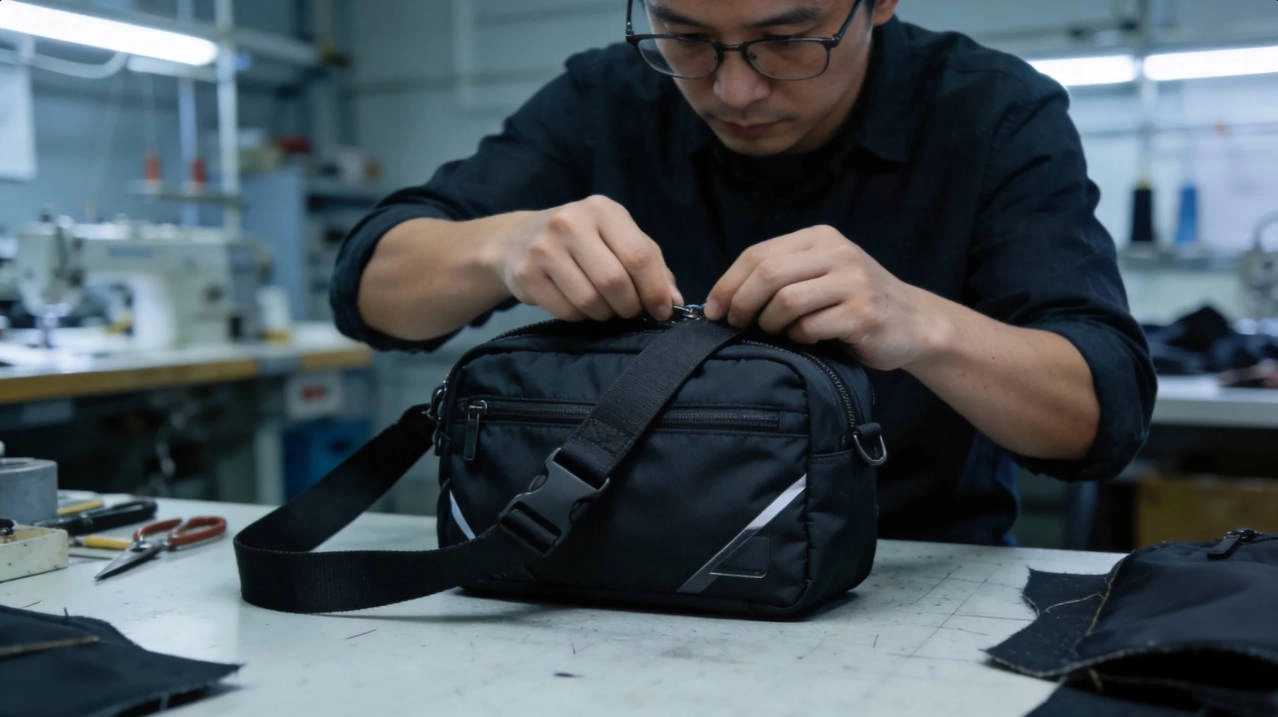
Requesting a sample from a handbag factory sounds simple. In practice, it's one of the most misunderstood stages of the entire product development process.
Done right, a sample round moves your project forward decisively — you end up with a physical product that confirms your design is manufacturable, your materials work together, and your factory can execute to your standards. Done poorly, it turns into an expensive, time-consuming loop of revisions that could have been avoided with better preparation upfront.
This guide covers the complete sampling process — what to prepare before you request, what types of samples exist, what to expect during the process, how to evaluate what arrives, and how to give feedback that actually leads to improvement.
The Different Types of Samples
Not all samples are the same. Factories use different sample types at different stages of development, and understanding which one you need avoids confusion and wasted cost.
| Sample Type | Purpose | When to Use |
|---|---|---|
| Proto Sample | First physical interpretation of the design — may use substitute materials. Tests construction and silhouette. | Early concept validation |
| Development Sample | Refined version with correct or near-correct materials. Tests fit, function, and construction quality. | Main revision rounds |
| Pre-Production Sample (PP Sample) | Made with exact production materials and methods. Must be approved before bulk production begins. | Final approval before bulk |
| TOP Sample (Top of Production) | First unit off the bulk production line. Confirms bulk matches the approved PP sample. | Quality assurance during production |
| Salesman Sample (SMS) | Used for sales, photography, and trade shows. Usually made to high cosmetic standard. | Marketing and sales use |
For most custom bag projects, the process moves through proto → development → pre-production. Each stage refines the product toward the approved standard that bulk production will be measured against.
Step 1: Prepare Before You Request
The quality of a sample is directly proportional to the quality of the brief you provide. A factory can only make what it understands — and what it can't understand, it will make assumptions about.
Before requesting a sample, prepare:
Design reference
A sketch, tech pack, or detailed reference images showing the bag from all angles. The more specific, the better. If you have a reference sample (an existing bag you want replicated or modified), include that information clearly.
Material direction
Which fabric, which finish, which color? If you have Pantone references or physical swatches, provide them. If you're open to the factory's recommendation, say so explicitly — and specify the quality level and price range you're targeting.
Hardware specifications
Zipper type, hardware finish, strap hardware. If you have preferences, state them. If not, specify the aesthetic direction (e.g., "all hardware in antique gold, matte finish preferred").
Priority list
What matters most in this sample? Silhouette accuracy? Material quality? Interior functionality? Being explicit about your priorities helps the factory allocate attention correctly — and helps you evaluate the result against what actually matters for your product.
💡 Tip: If you're working with a factory that has an ODM style library, ask to see styles close to your concept before commissioning a full custom sample. Starting from a base style that's 70% of the way there is significantly faster and cheaper than starting from scratch — and the end result can still be completely unique to your brand.
Step 2: Understand Sample Fees
Sample fees are standard in professional handbag manufacturing, and a factory that charges them is operating honestly.
Here's why: developing a custom sample requires real labor and real materials. A pattern maker has to develop or adapt a pattern. Material has to be sourced and cut. A skilled sample room worker has to assemble the piece — often more carefully than a production-line worker, because sample quality is scrutinized more closely. None of that is free.
Typical sample fee structures:
- ODM style with minor customization — lower fee, sometimes waived for serious buyers, because the base pattern already exists
- Modified ODM (significant design changes) — moderate fee reflecting pattern adaptation work
- Full custom OEM — higher fee reflecting new pattern development, material sourcing, and assembly from scratch
Most factories credit the sample fee against your first bulk order — so if you proceed to production, you effectively get the sample cost back.
In China's current manufacturing environment, labor and sourcing costs for custom sampling are genuinely significant. A reasonable sample fee is a sign of a factory that takes the work seriously.
Step 3: What Happens During Sample Development
Once you've submitted your brief and agreed on sample fees, the factory's sample room begins work. Here's what's happening on their end:
Pattern development
The pattern maker creates or adapts the paper patterns — hard card templates cut to the shape of each component — based on your spec or reference. This is where dimensions get translated into physical cutting guides.
Material sourcing
The factory sources or pulls from inventory the fabric, lining, hardware, and trims required. For custom materials not in stock, this can add days to the timeline.
Sample room assembly
A sample room worker assembles the bag following the pattern and construction sequence. Sample room work is done by more experienced workers than general production — because samples require more judgment and precision.
Internal review
Before shipping to you, a responsible factory reviews the sample internally against the brief. Issues caught at this stage are fixed before the sample leaves — saving a revision round.
Dispatch and shipping
The sample is photographed, packed, and shipped. Express courier (DHL, FedEx, UPS) is standard for sample delivery — transit time from China to Europe or North America is typically 3–5 business days.
📋 At Camcue, sample development happens at our Dongguan R&D center, where our dedicated sample room team handles pattern development, material sourcing, and assembly. Clients receive photos of the completed sample before it ships — so you get a first look before the courier even picks it up.
Step 4: How to Evaluate the Sample When It Arrives
Don't evaluate a sample based on first impressions alone. Work through it systematically.
Dimensions
Measure every dimension specified in your brief against the actual sample. Use a tape measure. Don't estimate. Record the actual measurements and compare them against spec.
Materials
Is the fabric the right weight and texture? Does the color match your reference in natural light? Check the hardware finish — does it match what was specified?
Construction quality
Examine the stitching under good light. Is the stitch density consistent? Are corners sharp and even? Are seams aligned? Any skipped stitches or loose threads?
Edge finishing
On PU leather and leather styles, check the edge paint: is it even, fully covering the cut edge, free of drips or bare spots?
Hardware function
Open and close every zipper multiple times. Engage every snap and closure. Test every buckle under tension. Hardware that works smoothly in the sample should work smoothly in bulk — if it doesn't work in the sample, it won't improve in production.
Interior
Is the lining neatly attached? Are pocket openings positioned correctly and wide enough to use? Is the interior clean — no raw edges, no excess adhesive?
Logo and branding
Is the logo in the right position? Is the embossing depth correct? Is the print quality clean?
Overall impression
Put the bag down. Pick it up again. Does it feel like the product you intended? Does it represent your brand at the level you need?
Step 5: How to Give Feedback That Works
Sample feedback is where many projects slow down unnecessarily. Vague feedback leads to guesswork on the factory's side, which leads to another sample that's still not right.
Effective feedback is:
- Specific — "The front pocket zip needs to move up 3cm" not "the zip feels wrong"
- Referenced — annotate photos of the sample with arrows and measurements where possible
- Prioritized — distinguish between must-fix issues and nice-to-have improvements. A factory needs to know what's blocking approval and what's optional.
- Consolidated — send all feedback in one communication, not in installments over several days. Scattered feedback causes confusion and delays.
A useful format: photograph the sample, annotate the images with numbered comments, then provide a written list corresponding to each number. This gives the factory a clear visual and written reference — and creates a paper trail for what was requested in each revision round. At Camcue, our internal tracking system uploads the original sample brief and each revision sheet as a written record. Clients can view all revision history in real time through our portal — so nothing gets lost across multiple rounds of communication, and any error can be flagged and corrected immediately.
How Many Sample Rounds Should You Expect?
| Project Type | Typical Sample Rounds |
|---|---|
| ODM style, minor customization | 1–2 rounds |
| Modified ODM, significant changes | 2–3 rounds |
| Full custom OEM, detailed brief | 2–3 rounds |
| Full custom OEM, vague brief | 3–5+ rounds |
More rounds are not always a sign of a bad factory — complex products genuinely require more development. But if you're on round four or five of a relatively simple style, it's worth asking whether the root cause is the factory's capability, the clarity of the brief, or a mismatch between the two.
From the Floor

Sample development is the most important early step in any order — and detailed communication upfront is what shortens the development cycle. This is exactly where a tech pack earns its value, and it's the point most people overlook. Sample room work is more careful than bulk production, but if the supplier hasn't clearly aligned with the client on the tech pack or inspection standards — stitch count tolerances, acceptable deviation in logo print placement, even the direction of edge finishing — those ambiguities will surface at final inspection as disputed defects. If the factory agrees to rework, that's the best-case outcome. But some processes simply can't be fully reworked. At that point, the cost exceeds what it would have taken to remake from scratch. On sample fees: bag development is genuinely complex, with many production steps. On a low-margin order with multiple revision rounds, sample costs alone can approach the entire net profit. Even when a supplier promises free sampling, those costs are calculated into the unit price somewhere. It's better to discuss openly how sample fees are structured. And once a sample is approved, switching suppliers introduces significant new uncertainty — the new factory is starting from zero. Long-term clients typically work out structured arrangements with their suppliers — annual volume thresholds that waive all sample fees, tiered fees by complexity, sample costs folded into unit price at a discount, or fee waivers on high-margin styles. These arrangements reflect the real economics on both sides.
Ready to Request Your First Sample?
Start With a Concept. We'll Handle the Rest.
Send us your design brief — sketch, reference images, or written notes. Our Dongguan sample room will develop your prototype and share photos before it ships. No minimum order quantity.
Request a Sample →